

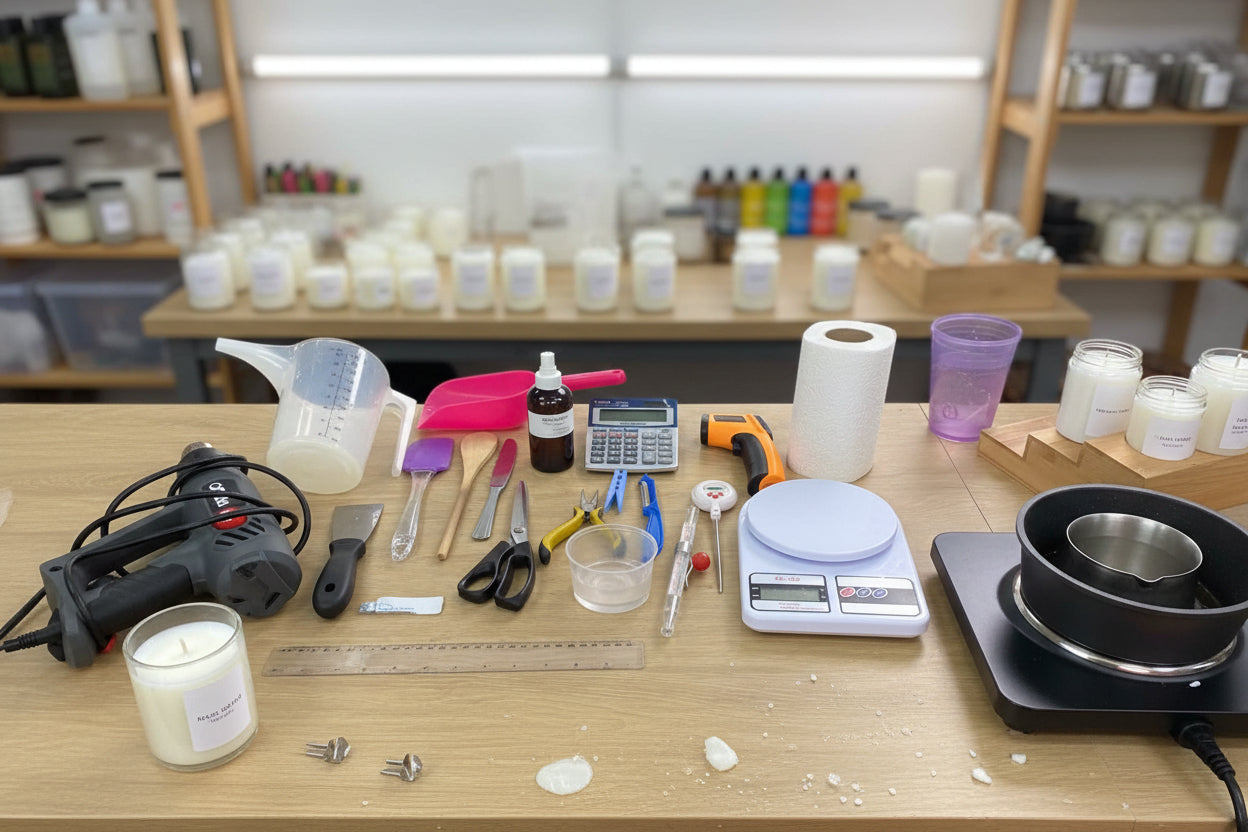
There’s nothing worse than starting a project unprepared. In this guide, we’ll walk you through the essential setup so you have everything you need for an easy, enjoyable candle-making experience.
The good news? Many of these items are things you may already have at home, making candle making a very cost-effective and accessible hobby.
Equipment Required for Candle Making
Before you begin, make sure you have the following candle making equipment list ready:
- Stove top or cooktop (electric or gas)
- Double boiler pot
- Melting pot (included in our starter kits)
- Measuring cup (included in our starter kits)
- Thermometer (included in our starter kits)
- Digital scales
- Trivet
- Ruler
- Paper towel
- Stirrer or large spatula
- Vegetable peeler
- Small pliers
- Scissors
- Notepad and pen
- Calculator
- Blu-tack
Heat gun or hairdryer (optional)
Checkout this VLOG on the subject here - Candle Making - Plan Prepare Play
Shop all candle making supplies at Glassware Imports.
Candle Supplies & Raw Materials
Once your equipment is ready, it’s time to source your candle supplies and raw materials. When starting out for the first time - purchasing a starter kit is the best way to go because we’ve taken all the guess work out of it for you. You will have everything you need to dive in and start creating.
The quality and reliability of your ingredients directly impacts the quality of your end product. So don’t compromise the integrity of your ingredients, be sure to buy from long standing and dedicated candle making suppliers like us at Glassware Imports.
Now it’s time to source your candle supplies and raw materials:
- Soy wax
- Fragrance oils
- Candle containers (jars, tins, ceramics)
- Wicks
- Wick tabs
- Candle dyes/colour
- Stickums (adhesive for wicks)
- Warning labels
- Tealight containers
- Melt containers
- Wick holders
Tip: Our candle making workshops and starter kits include many of these essentials to get you started quickly.
Why Soy Wax is the Best Starting Point
If you’re new to candle making, soy wax is the perfect place to start. Once you master it, you can explore other wax types with confidence.
There are so many things I love about working with soy wax. If you are new to candle making start with learning to work with soy wax and once this is a solid skill, then you can start changing it up and modify your practise.
Benefits of Soy Wax
- Clean Burning: Produces minimal soot compared to paraffin
- Longer Burn Time: Typically burns 2–3 times longer
- Natural & Renewable: Made from soybeans
- Biodegradable: Environmentally friendly
- Great Scent Throw: Holds fragrance well
- Vegan Friendly: No animal-derived ingredients
- Lower Melt Point: Safer and easier to work with
- Water Soluble: Easy to clean up
Fragrance Oils: The Key to Repeat Customers
Fragrance is what sells your candle—and what keeps customers coming back.
Always choose high-quality fragrance oils specifically designed for candle making. If a product is not clearly labelled as safe for candles, don’t use it.
Avoid buying cheap, generic oils from marketplaces. Poor-quality fragrance oils can impact both performance and safety.
What About Essential Oils for Candle Making?
In my experience, essential oils are not ideal for candle making. They are not designed for combustion and often have low flash points, making them highly volatile under heat.
For consistent, safe, and high-performing results, stick with professionally formulated fragrance oils.
They are not made for any heat or combustion applications. They have a very low flashpoint, which means they are highly volatile and you don’t want to be putting something highly volatile in a combustion application.
Choosing the Right Candle Container
Candle containers come in many forms such as glass jars, ceramics, and metal tins are the most common. You can make candles in a wide variety of containers from glass jars, ceramic jars, candle travel tins. The fundamentals are that it must be strong, sturdy and capable of withstanding high heat from the burning candle. Best option of course is to buy from an official candle supplies website like Glassware Imports, we offer a large selection of colour and size options.
The key requirement is simple:
- Must be heat-resistant
- Must be structurally sound
We always recommend sourcing containers from a trusted candle supplier to ensure safety.
Repurposing Household Items
You can reuse items like jars or teacups—but they must be tested.
Basic heat test:
Place the container in a 150°C oven for 20 minutes.
If it withstands this, it’s generally suitable for candle use.
Candle Wicks: The Most Critical Component
Choosing the correct candle wick is fundamental to both performance and safety.
- Small wick + large jar = tunnelling
- Large wick + small jar = overheating risk
The wick controls how wax is drawn to the flame and how your candle burns.
Common Wick Issues
- Tunnelling (wax left on edges)
- Large or flickering flame
- Sooting (black smoke)
- Overheating containers
How Do I Test My Wick?
To test your candle wick, it’s best to use three to five similar candles with different wick sizes. You want to burn them simultaneously and compare the results. You can also test various kinds of wicks to determine which works best with your candles. Each test should allow for a full melt pool to form.
While tools and materials are essential, don’t overlook your own creativity and intention.
Every candle you make carries your personal imprint, your attention to detail, your care, and your energy. These intangible elements are often what set one brand apart from another. Never underestimate the impact of that.
If you want to dive straight in, consider our comprehensive Online Candle Making Masterclass. Learn to make scented Soy Candles, Room Sprays, Perfumes & Diffusers that will rival the professionals! YOU’LL NEVER PAY RETAIL PRICES AGAIN!!!
We deliver candle making supplies across Australia. Browse our variety of candle containers & jars among other candle supplies. If you have any questions regarding placing and ordering or locating products on our website please contact us.


